How It Works / Hustle Points Over Time
One conversation starts it.A season of conversations builds the story.
Every practice and game adds another moment to look back on. Over time, Hustle Points gives families a way to see effort, notice patterns, and keep the conversation focused on the things young athletes can control.
See the season add up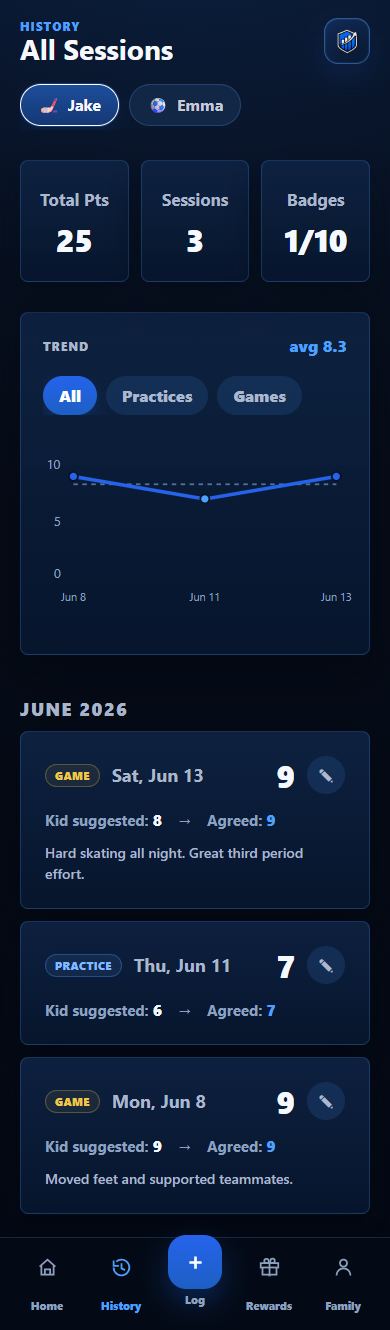
A record of the conversations
See the season add up.
Every logged practice and game becomes part of the season's Hustle Points history. Families can return to the moments that shaped the conversation—not to grade the season, but to remember it.
- Total Hustle Points01
- Number of sessions02
- Average scores03
- Practices and games04
- The child's original score05
- The score agreed on together06
- Notes from the conversation07
Give practice a place in the story
Practices matter. A lot.
Games are where kids often measure results. Practices are where much of the development happens.
Hustle Points gives practices the same place in the conversation as games, helping young athletes build good practice habits around effort, engagement, and making the most of every repetition.
Practice effort is worth paying attention to.
Better practice habits create better opportunities for skill development.
Data should create questions
Notice the patterns.
Over time, the history may reveal something worth talking about.
“Your weekend practices seem to have lower Hustle Point scores than your weekday practices. Why do you think that is?”
Child“I stay up later on Friday nights.”
Child“Those practices are really early and I don't eat much beforehand.”
Child“I don't know.”
That's okay too. The parent's job is not to diagnose the graph. The pattern creates another question.Reflection over perfection
Growth isn't a straight line.
The goal of Hustle Points is not to turn every score into a 10. A lower score is not automatically a bad result.
Sometimes a 4 creates a more valuable conversation than a 9.
Child“I think I was only a 4 today.”
Parent“Why do you think it was a 4?”
Child“I didn't have great energy today. I don't think I ate enough before practice.”
The result is not the four points. It is the reflection and growing self-awareness.Growth doesn't mean every score goes up.It means the conversation gets better.
Over time
From reflection to intention.
Repeated conversations can help young athletes become more aware of their effort, recognize patterns, and begin thinking intentionally about the things they can control.
“How many Hustle Points do you think you earned today?”
“I'm getting more than an 8 today.”
Reflection can begin to become intention. Every child and every season will take its own path.